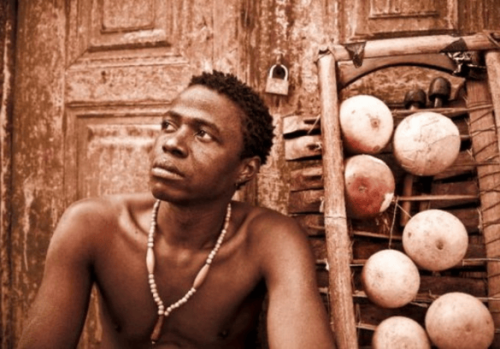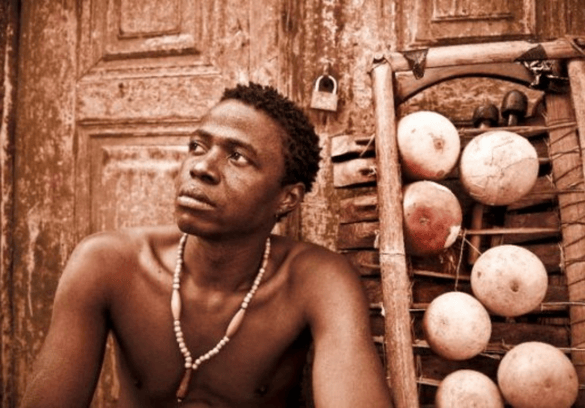
Kimi Djabaté was raised in Tabato, Guinea-Bissau, a village known for its griots, hereditary singer-poets whose songs of praise and tales of history and legends play an essential role in Africa’s musical life.
His parents gave him his first balafón when he was three years old. His early introduction to a variety of traditional instruments laid the foundation for his later mastery of the guitar and skill with a range of percussion instruments. Djabaté’s talents proved both a gift and a burden, as his family often forced him to sing and dance against his will, and he had little time to partake in the carefree fun and games of other children his age.
In 1994, when he was just nineteen, Djabaté made the difficult decision not to return to Africa and instead settled in Lisbon, Portugal, where he forged connections in the local music scene and further developed his unique, personal sound. Throughout his years in Europe, Djabaté collaborated with many other exceptional musicians, including Mory Kanté, Waldemar Bastos and Netos de Gumbé, among others. Recently, Djabaté has worked with the pop star Madonna and was a featured singer on her song “Ciao Bella”.
Djabaté’s parents and uncles provided the young phenom with excellent training in traditional Mandingo music, but Djabaté was also interested in popular African genres such as the local dance music style gumbé, Nigerian Afrobeat and Cape Verdean morna, not to mention western jazz and blues.
In 2005, Djabaté independently released his first solo album, Teriké, followed by Karam in 2009, which was released by Cumbancha and met with resounding praise. His third album, Kanamalu, came out in 2016. Djabaté’s albums pay tribute to his griot heritage and the spirit of Africa, laying a foundation for his latest musical masterpiece, Dindin, released by Cumbancha in 2023.
The central themes of Djabaté’s music are the joys and challenges of life in Africa, from freedom and poverty to the rights of women and children and the many forms of love. Continuously optimistic about the power of music and its message to create a better future for Africans, Djabaté’s magical songs remain uplifting and hopeful even as they reflect on contemporary struggles and challenges. An expression of his griot roots, Djabaté pays tribute to the people, soul and spirit of Africa that is at the heart of his music.