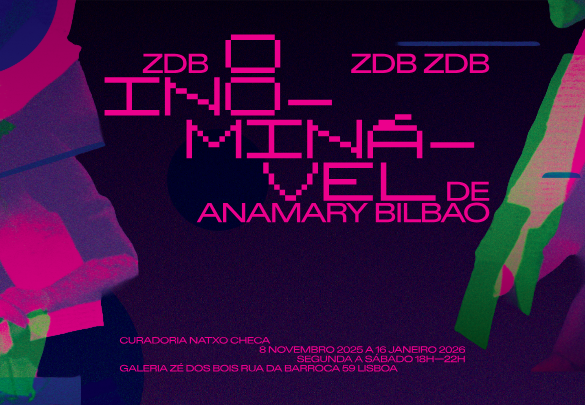
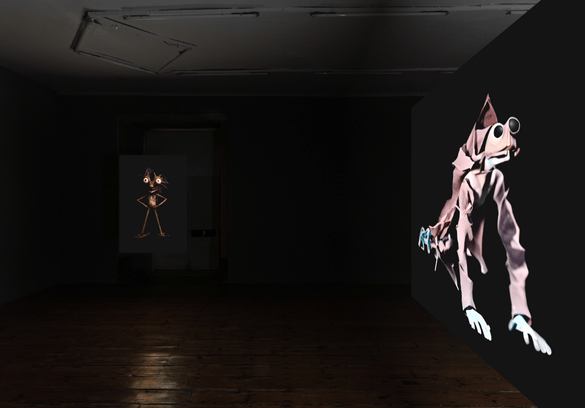
O Inominável (The Unnamable), a work created for the exhibition of the same name at Galeria Zé dos Bois, stems from AnaMary Bilbao’s curiosity about the role of the conductor within the orchestral context and the power dynamics assumed by this figure. When the roles of conductor, performer, and composer become blurred, this seemingly rigid architecture — who controls/who executes/who is controlled — appears to dissolve. This dilution of the original logic led the artist to delve into the history of music in order to understand the social, political, and cultural implications and repercussions of these structures of control.
The entire 20th century was the scene of attempts to subvert the power of the conductor’s gesture. Luciano Berio composed the work Sinfonia (1968-1969) during this period, marked by intense political upheaval and the furious emergence of new forms of communication. The piece, composed for eight amplified voices and a large orchestra, articulates multiple literary and musical layers throughout its five movements. There are countless gestures of fragmentation in a space that demonstrates excess and the impossibility of grasping the whole, dismantling the traditional model: instead of subjecting the musicians to a centralizing gesture, it opens up fissures, frictions, and simultaneous layers that escape the full control of any central authority.
Incorporating excerpts from the translated version of Samuel Beckett’s The Unnamable (translated by the author in 1958 from the original L’Innommable, 1953), the third movement of Berio’s piece, III In ruhig fließender Bewegung (1968), highlights the autonomy of the sound fabric in a multiplicity that self-organizes, interrupts, and contradicts. The fact that it draws on The Unnamable makes this moment the quintessential moment where the most disruptive notions of control are summoned. The Unnamable, who appears in Beckett’s book, is an anonymous figure, always undefined between thought, word, and the impossibility of acting, which in turn reveals his inability to be — an autonomous, active subject. The final sentence of the novel — “I can’t go on, I will go on” — translates this infinite cycle into a tension between control and freedom, presence and absence, visible and invisible.
This third movement is therefore the structuring core of the piece developed by AnaMary Bilbao. The awareness between what Beckett formulates literarily and what Berio achieves musically — the impossibility of control and the constant oscillation between the search for meaning and collapse — offers the key to thinking about how today, more than ever, this same tension shifts to the image, to technology, and to contemporary systems of producing meaning, namely social networks, digital platforms, and artificial intelligence.
O Inominável (2025) proposes a field of friction where multiple temporalities intensify and collide, and where Beckett’s unspeakability resonates as a kind of existential mantra that compels us to continue, even though we no longer find meaning in doing so: “Where now? Who now? When now? Unquestioning. Unbelieving. Questions, hypotheses, call them that. Keep going, going on, call that going, call that on.” (Samuel Beckett, The Unnamable).
Keeping in mind the legacies of Beckett and Berio, AnaMary problematizes them through a new gesture: she submits the excerpt from Sinfonia to an artificial intelligence program that promises to separate compositions’ instruments and voices in an unaltered way. However, the system fails. Unable to isolate layers, neglecting instrumental sounds or translating them into noise, transforming female voices into indecipherable moans and preserving only Beckett’s fragments (which are themselves indefinable), the failure paradoxically becomes part of the work — a new metaphor for control systems and their inability: a structure designed to control by deception, which ultimately reveals its inability to do so.
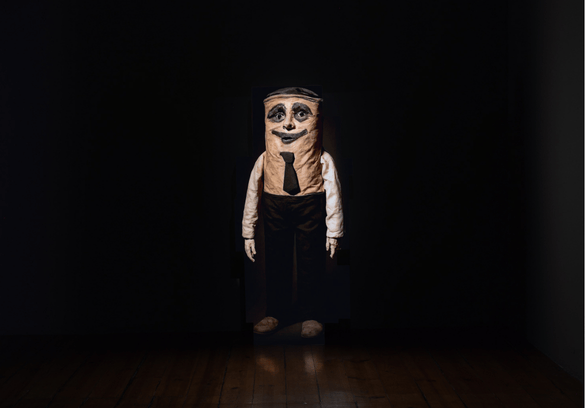
Such technological inconsistency serves as a diagnosis of our time: the crisis of representation, the collapse of certainties, disbelief and fragility in the historical authority of control bodies. A figure evocative of something between a paper bag and a cigarette butt stages what we might consider the prologue to the exhibition — chanting in a loop the phrase “No control, I can’t believe I’ve no control” from David Bowie’s song No Control (1995), it appears anguished and resigned to its submission to this entropy.
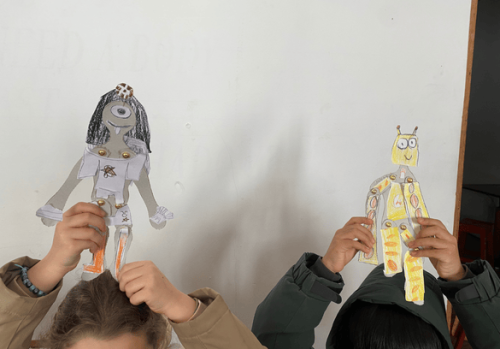
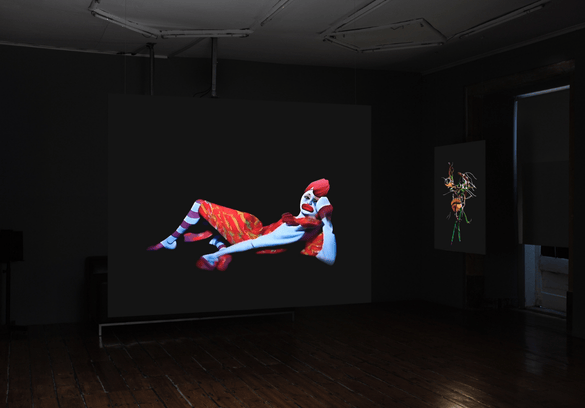
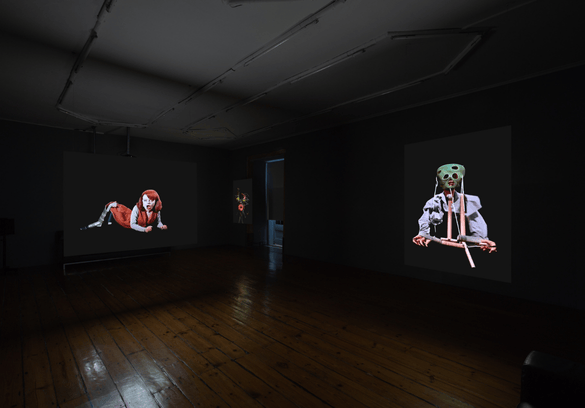
Translating words into sound, sound into noise, noise into image, O Inominável (2025) exposes the collapse of power structures that go hand in hand with the desire for control, while recalling its implications within the spheres of knowledge, gender and identity, and the environment (Nature, in the “more-than-human” sense). O Inominável (2025) is distributed among three main figures, archetypal of the three fields mentioned above, attuned to each other and vocalizing the sound-noises that remain from the reinterpretation mediated by contemporary technology that has failed in its promise of faithful restitution.
In the approximately six minutes of duration, the loss of meaning of the sounds is accompanied by the process of image disruption, where the visual sequences assume representative failures, again produced by technological tools that aim to guarantee a future of transparency and precision. These sequences were subjected to multiple attempts of disruption (and control) by the technological process itself, but also by the creative process. Throughout this process, when the images obtained drifted into expected forms under the command of AI, they were diverted with images of bacteria, cancer cells, movie frames, among others. This deliberate confrontation illustrates the tension between the incompetence of the machine and the human impotence to control the very destiny of the work by introducing new images to enhance new derivations and meanings.
In this context, the software’s inability to restore the integrity of the sound tracks, as well as to maintain the visual fidelity of the images, was not approached as an accident, but rather as a symptom of an ecosystem where technical mediation amplifies, rather than resolving, the unspeakability originally proposed by Beckett and reiterated by Berio.
And it is precisely in this failure, in this collision of forces, that the work finds its political echo: an attempt to mirror contemporary society plunged into a limbo where neither words, nor sound, nor images can stabilize meaning. The figures that emerge from this process do not, therefore, represent a new field of control, but rather the fullness of this dissolution on all fronts — bodies that, like Beckett’s voice, persist in a state of suspension between power and impotence, between intention and failure, in the growing impossibility of converting thought into action, in the loss of agency, in the awareness of existence in an unnameable time, one that, rather than resisting, survives without ever being fulfilled: a time when what remains of humanity is trapped in an interval where nothing can be fully said, controlled, or concluded, but where, paradoxically, it continues to chant the irrepressible need to go on: “Where now? Who now? When now? … Unbelieving.”
The Unnamable (1953), by Samuel Beckett