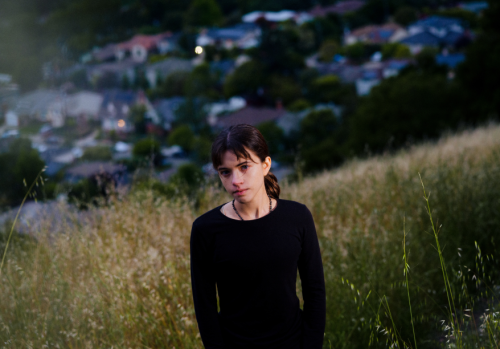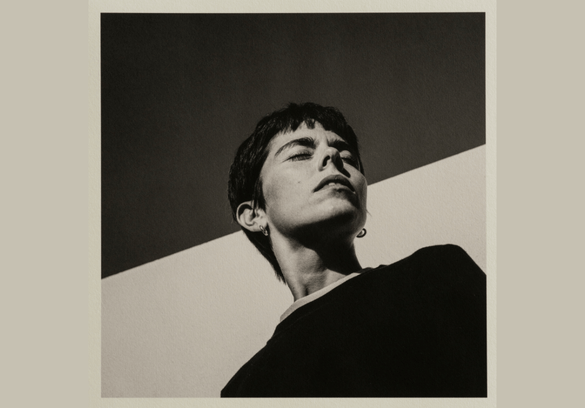
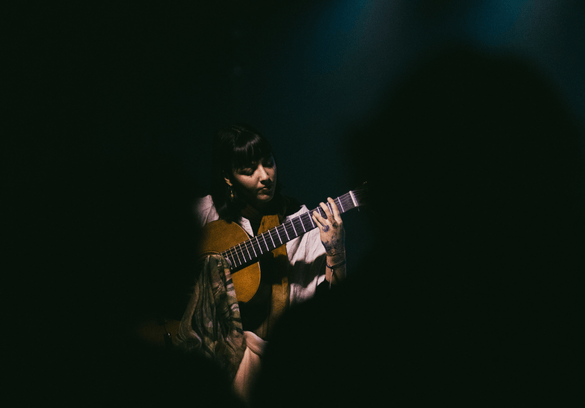
Anna Ferrer took us by storm at the end of last year with an album that fits in with a reworking of different variants of Spanish folk music that has been happening with a generation of new artists. From Menorca, Anna Ferrer works on Parenòstic ideas of local folklore. It is not just a question of sound, but of tradition, habits, and imagination. Even language. This reworking, whether by Ferrer, her contemporaries such as Tarta Relena, or, on another level, Marina Herlop (who visited us recently), has a strong academic foundation and sets out on a new path that is not accidental but sustained by ideas of the new and of how to recreate a new folklore that neither imitates nor limits the old.
Anna Ferrer’s voice is central to her music. The keyboards and guitar exist to create a soundscape, but the primary sensation of this music is the voice. The instrumentals are skeletal, a kind of basic orientation for what arises, which does not exist in a vacuum. The voice therefore occupies the space, and can be heard even when Anna Ferrer is not singing, like an echo. This is perhaps the main difference between Ferrer and other examples in the same vein, from Spain and elsewhere: she seeks a more earthy, guttural connection with the idea of folklore.
Heard like this today, this idea of tradition and folklore is more connected to origins/roots than might be suggested. That is, Anna Ferrer feels more earthy than her contemporaries, as if by exploring the past and tradition, she realizes that there is no other way out but to explore the rarest depths of this sound. In the songs we know, Ana Ferrer unveils the guttural nature of the earth, the weight of the secrets of the past through a voice that is heard and echoes through these sounds of the earth. Menorca is the point of origin, the destination is the world. And that now passes through Lisbon. AS


Music
Concerts
Andreu Ubaldo & Kiran Leonard
Thu17.12.2609:00PM
Galeria Zé dos Bois