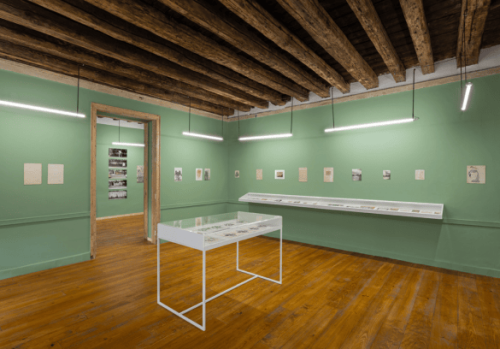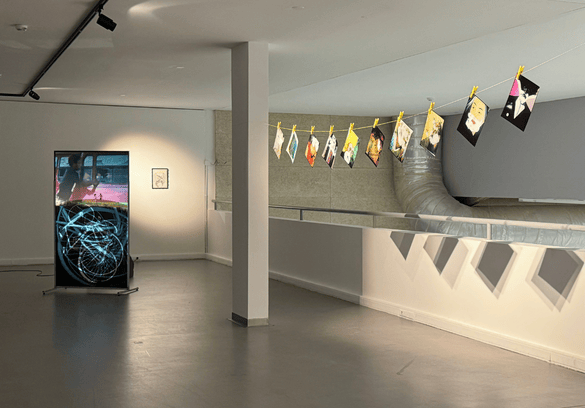
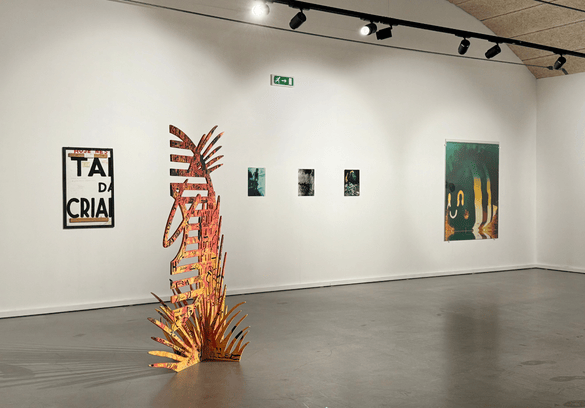
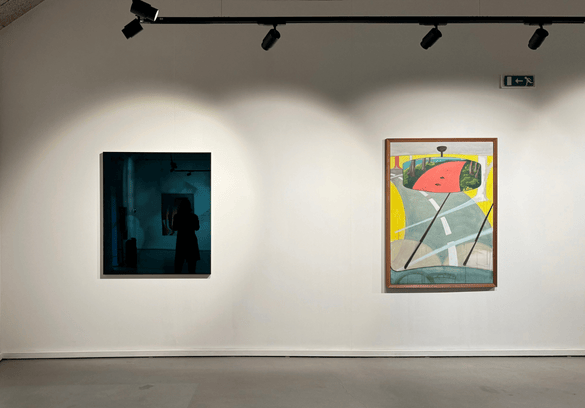
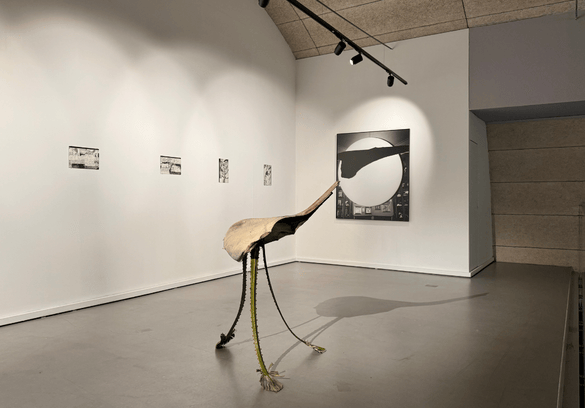

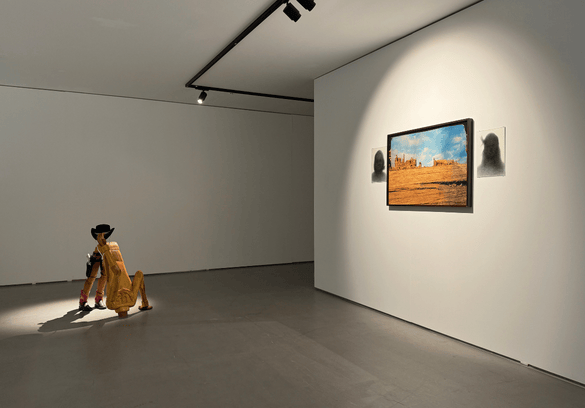
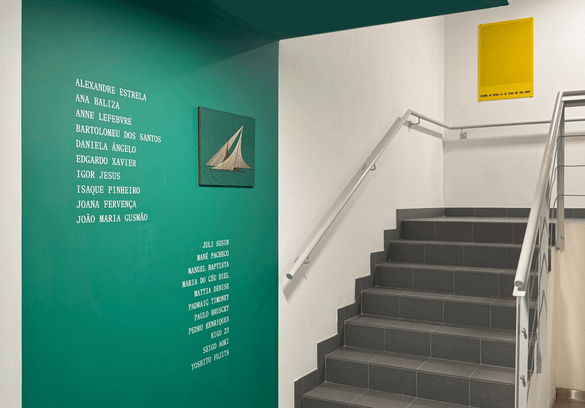
The title of the exhibition gathered here: ESCOLA DE GRONINGEN (GRONINGEN SCHOOL), surreptitiously stolen from one of the works on display, refers to the Department of Mathematics at the University of Groningen, which was particularly relevant in the post-war period in the study of classical geometry, kinematics, and applied mathematics.
Contrary to the analytical trend of abstraction that dominated advanced mathematics at the time, the geometer Oene Bottema (1901-1992), a leading figure at this institution of learning, sought to apply the science of numbers to the real world.
Revisiting Euclidean geometry as developed until the end of the 19th century, Bottema had the vision to modernize it to the rigorous standards of the 20th century, contributing to the unveiling of complex spaces and movements through exact science—in particular, the inversion of circles, Moebius transformations, and geometric configurations in the context of invariants and kinematic systems.
In light of these contributions, the curved surface of the potato chip “pála-pála”, could be described in three Cartesian coordinates by the simple equation z = y2 – x2, as well as the parabola, defined by a second-degree equation, describing the wiring of the 25 de Abril bridge, a satellite reception antenna, and the headlights of a car.
…
We are interested in the intuited derivations of these mathematical equations, which originate from a speculative world rather than the mere formulas that describe them on paper. We are interested in their consequences in material production at sea, in the way that conceptual power can generate artistic processes as distinct and authentic as arborescences or Galician seafood. We are interested in artistic production that manages to shape the speculative into understandable and kinetic forms; a driving force dedicated to discovery; a demiurgy superior to logic that gives rise to new ideas and new expressions of the intellect.
“Good Thoughts, Good Words, Good Deeds.”
– Zoroastro Bêbado