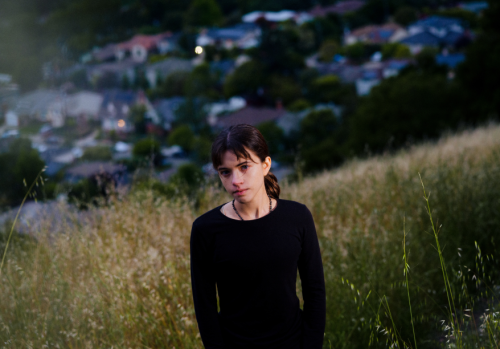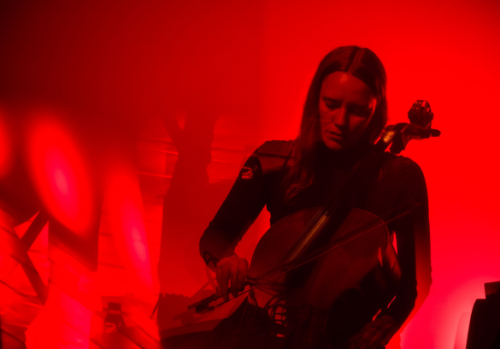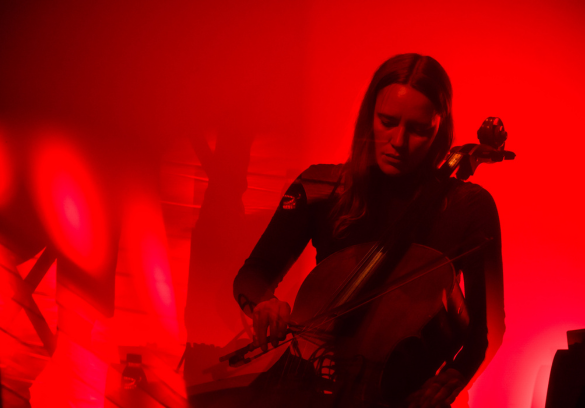
A Franco-American artist based in Brooklyn, Leila Bordreuil has been exploring unconventional approaches to the cello which, whilst not merely mimicking extended techniques, branch out from the instrument’s inherent character into drone-like landscapes and visceral eruptions of noise, embracing all manner of materials and possibilities in this journey through the fire. Having collaborated with artists such as Laurel Halo and Bill Nace, Bordreuil has steadfastly explored the interstices and junctures between improvisation, contemporary composition and noise in a patient body of work, approached with equal parts planning and dedication. And feeling. By largely eschewing the use of effects pedals and other electronic devices, she anchors the instrument – its body, strings and resonances – to the surrounding space and a meticulous amplification process, laying the foundations for music that so fully realises its acoustic potential – La Brute – as it explores a vibrant sonic spectrum of resonances and harmonics – Headflush – or allows itself to be carried away by a melancholy that is rooted as much in the forging of fire music as in a tense liminal suspension – i.e. the two tracks from the highly, highly recommended ‘not an elegy’. More recently, 1991, Summer, Huntington Garage Fire, released on Aaron Dilloway’s Hanson label, surrenders itself completely and almost tangibly to noise and evocative passages, as if rescued from the mist of memory. Beautiful. Geophonics, due for release any day now on Superior Viaduct, opens a new window onto this process, captured in the immediacy of the moment, unrepeatable: circular cello feedback via an amplifier in physical contact with a grand piano, which, in reaction to the sound, resonates its strings in a hypnotic and ever-changing flow.
BS